We are sharing notes from an introduction to mediation which comrades have shared with us, for anyone who wants to deepen their understanding of and skills in mediating conflicts. Understanding mediation is intrinsically linked to understanding conflicts and moving beyond their destructive potential – moving through the jungle of topics, bridging the river of emotions, to arrive at the plane where we clearly see interests, means – here is where we can find consensual solutions.
This article is not written as a linear workshop task, but main topics are addressed and some basic structural notes are given. Go back and forth as needed to understand, and the recommendation is that you get together with some friends, your collective, or whoever wants to learn, and do the exercises introduced and/or sit down and practice hypothetical scenarios in between yourselves! Mediation needs practice, so let’s start to practice it. As always, there are no rigid rules or lines to follow but adjust as needed to your specific setting.
There are many different approaches to mediation, some more neoliberal than others, and we do not claim to be experts but we do want to make accessible to as many comrades as possible some tricks around how to approach conflict situations – so take this with a grain of salt, it is not an anarchist manifesto, but we hope it can be useful. If you have other input to share, feedback, recommendations, don’t hesitate to reach out!
A gentle reminder to begin with: all realities are subjective and we all live in our realities, experiencing and living them as objective truth. There are no perfect victims or perpetrators, we all make mistakes.
CONTENTS:
COMMUNICATION
EMOTION & EMPATHY
CONFLICT
POWER
MEDIATION
PHASES OF MEDIATION
Phase 1: Introducing and establishing the framework
Phase 2: Presenting the different viewpoints and the conflict itself
Phase 3: Conflict clarification: going deeper
Phase 4: Searching for solutions, finding options, exploring
Phase 5: Agreement. Establishing terms
GROUP CONFLICTS
COMMUNICATION
We are always communicating, but we are not always very good at it. There is a lot to learn and practice our understanding of the many dimensions in relation to communication. Every message entails a web of messages on different levels.
The first thing to remember is that misunderstandings and annoyance is the rule, not the exception.
We cannot not communicate. Communication is a constant conscious and subconscious act that we do.
Communication happens on the message and meta levels – in gestures, tone of voice, as well as the language and signs.
There is always a content aspect, and every communication creates meaning.
Communication can be congruent and non-congruent.
When we encounter communication, we go through four steps:
- First we perceive: see, hear, etc – already on this level, it is selective and subjective what parts of the communication arrives to us
- Secondly we interpret: interpreting the situation, where the brain basically is trying to figure out what it is that’s going on in this specific situation
- Thirdly we evaluate: depending on our socialisation and our experiences we evaluate what is being communicated
- Fourthly we react: managing our action or lack thereof in respect to what we arrived at making out of the communication
When we speak to someone, there are four dimensions to that message:
- The presentation of the self: how am I presenting myself / what kind of a person is that?
- Relational dimensions: what is my relation to the other and what do I think about them?
- Factual level: what is it that is being talked about?
- Appeal dimension: what do I want to appeal for you (not) to do / what am I supposed to (not) do?
To go deeper in our relations between each other, and to be able to understand and support in resolving conflicts, we need to actively listen and try to be aware and to some extent take in these dimensions. For this, it is useful to practice active listening. Express your intention to listen and make this part of your relationship to the other person in this moment in non-verbal and para-verbal ways. Make sure you understand the content and reaffirm your intention to understand, through paraphrasing, asking follow-up questions. Try to verbalize what you think that is the core of the content of the message, repeat it to the person to see if you got it right. Avoid giving advice, adding your own stories, or evaluating what it is that’s being said to you.
EMOTION & EMPATHY
Conflicts and resolving them activate the same brain regions like a pain or a threat situation and our first response (functioning as protection) is a defensive one. To interpret this defensive reaction as a need takes practice, and is a challenge for the mediator.
When my are under threat, we send drastic signals to the outside, to warn others or establish boundaries. The empathic resonance declines until a turning point. Our empathy neurons usually makes us mirror the feelings we see in others. In a conflict situation, depending on degree of escalation, this can be reversed: so that when the other is feeling good, i feel worse and vice versa.
We all have our subjective realities, there is no objective one: but we (sometimes) act as if our constructed reality is universally valid. (This we have also spoken a lot about in the zine: it is one of the toxic traits of white supremacy culture and understanding others viewpoints and realities is something we should strive to practice ourselves in.)
When faced with defensive (re)actions, it is important to acknowledge and react to them, respecting the conflict parties. Their defensiveness is based in real feelings and they need it to be taken seriously. Keep in mind the basic principle that the conflict parties are the expert of the conflict: they know best what they need and want, mediators are merely trying to clarify the underlying feelings and values.
Mediation is person-centered:
- Listens without conditions
- Values people
- Shows empathy
- Enter into relation with the conflict in a consistent way
- Following the principle of “All that I say should be true, but not everything that’s true has to be said”
Affective empathy: happens on a neural level, basically mirroring neurons – “I feel what you are feeling”. The danger here is a loss of possibility to act due to overwhelming own emotions.
Cognitive empathy: being able to understand emotional processes – this is the basis for the development of (adequate) steps of action.
Social empathy: empathy with whole systems (groups, teams, collectives, etc) – reaction to system-inherent processes.
CONFLICT
The first step to be able to deescalate and resolve conflicts is to understand conflict in and of itself and how we understand generative conflicts. Conflicts are a good and necessary thing. Having conflicts are what let us grow. Taking the fear out of having them is an important part of managing our relationships, as well as doing any kind of mediation.
A social conflict is an interaction between actors, where at least one actor experiences incompatibilities in the thinking/feeling/wanting of the two actors, which in practice impairs them. It always consists of a material problem as well as a relationship aspect, specifically a disturbance in the relationship. It is not objective or material only, but takes on an emotional character.
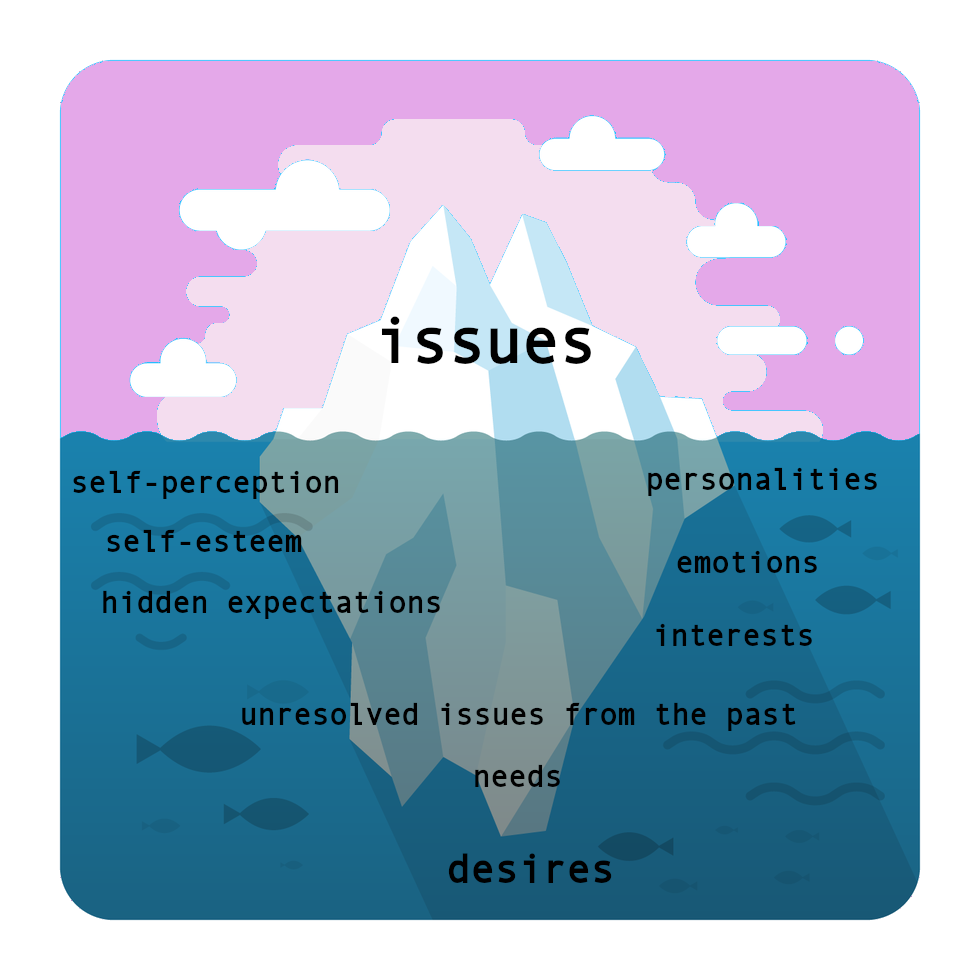
We can imagine conflicts like icebergs, where the biggest part is hidden under the water. Misunderstandings, hurt, emotions, relationship issues, interests, cultural differences, structural domination schemes, traumas – all of these and more play into it, but are not always visible and mostly not expressible. The work of the mediator is to go deeper.
Mediative (and a bit anarchist) conflict understanding
1) Conflicts are normal and everyday social phenomenons. Everywhere where there is people, there are conflicts. Try to cut your fear of conflict. (It is an oppressive technique of western capitalist racist society to make us afraid of conflicts. We actually need them and through de-learning how to have them we have been stripped of one our greatest power: our interdependency. Through interdependency and community, we grow less dependent on the systems we want to dismantle and it is ultimately a tool of struggle and liberation).
2) Conflicts in themselves are not good nor bad: they have constructive and destructive potentials.
3) Conflicts have reasons. The own position becomes clearer, I show the world what is important to me. Things and differences that were already there comes out in the open, and helps us to see (and hopefully understand) the subjective realities other people are living. (There is no one true anarchist utopia: we need to make space for many worlds as we strive for autonomy and liberation for all. In order to be able to do this, we need to also work on our patience towards other peoples’ subjectivities, and downscale our need to be correct, be right, have the last say, etc.)
4) Conflicts are life-threatening and vital at the same time: it depends on the perspective. How the conflict is being lived and the importance it has to me decides its potential.
5) Conflicts are complex and tricky. If they were easy, they would already be solved. The iceberg model applies: mostly we see only the very tip of the conflict/logic/values that we are confronting. It is not helpful to enter as a third party and classify it as simple, and with mediation, it is also not easily resolved. There are no obvious (or rational objective) solutions.
6) The conflict in itself is not the problem, but how we manage it. For example, avoiding conflict is complicating the managing of it. It can be helpful to work through the problematic managing in order to arrive at possible solutions.

GLASL – CONFLICT ESCALATION MODEL
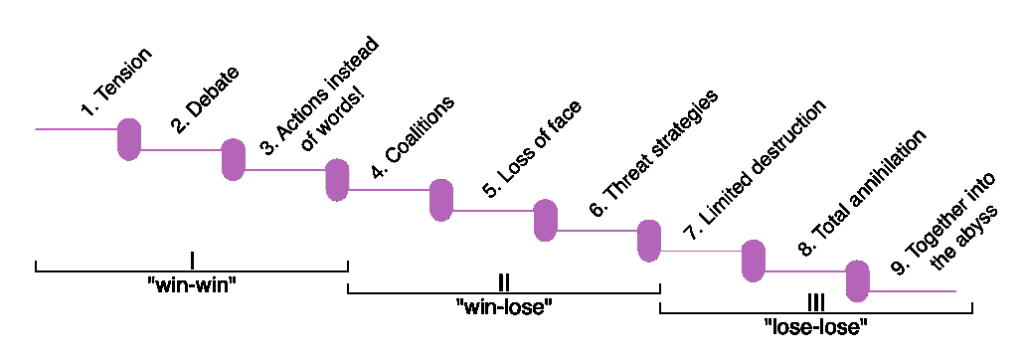
1st Level (Win–Win)
Stage 1 – Tension
Conflicts start with tensions, e.g. the occasional clash of opinions. This is a common occurrence and is not perceived as the start of a conflict. If there are deeper causes, and the positions become more fundamental, it escalates into conflict.
Stage 2 – Debate
From now on the conflict parties are trying to convince each other of their own arguments. Differences of opinion lead to disputes. The parties try to put each other under pressure and think in terms of black and white.
Stage 3 – Actions instead of words
The conflict parties increase the pressure on each other in order to assert their own opinion. Discussions are broken off. No more verbal communication takes place and the conflict is increasingly exacerbated. Sympathy for “the other” disappears.
2nd Level (Win–Lose)
Stage 4 – Coalitions
The conflict is expanded by both sides trying to gain support for their side of the conflict. Believing blindly in the rightness of one side, the opponent can easily be denounced. The original issue is no longer important: one has to win the conflict so that the opponent loses.
Stage 5 – Loss of face
The loss of trust is complete. Loss of face means in this sense the loss of moral credibility.
Stage 6 – Threat strategies
The conflict parties try to gain absolute control by issuing threats which demonstrate their own power. One threatens, for example, with a demand (10 million euros) which is enforced by a sanction (“otherwise I′ll blow up your main building”) and underlined by the potential for sanction (showing the explosive). The proportions decide the credibility of the threat.
3rd Level (Lose–Lose)
Stage 7 – Limited destruction
Severely damaging the opponent is intended with all the tricks possible. The opponent is no longer regarded as human. From now on, limited personal loss is seen as a gain if the damage to the opponent is greater.
Stage 8 – Total annihilation
The opponent is to be annihilated by all means.
Stage 9 – Together into the abyss
From this point personal annihilation is accepted in order to defeat the opponent.
The ways in which we can try to intervene and deescalatate obviously depends on the level of escalation in the conflict. Mediation typically is most useful at the first three steps, when it is still possible to arrive to a solution with mutual gain, and once it has gotten much deeper it can be necessary to do forceful interventions to avoid harm. The mechanisms that escalate conflicts are by Glasl understood as 1) expanding the arena of conflict, 2) simplifying and personalising, where an enemy image is created, and 3) pessimistic anticipation which becomes a self-fulfilling prophecy.
CONFLICT BEHAVIORAL PATTERNS
Conflict intelligence means to be aware of your own patterns and be able to identify that of others. Developing it means understanding different ways of dealing with conflict; what works for whom; provide support to different kinds of people. All conflict behavioral types have their constructive and destructive potentials. There are no good or bad patterns: we learned them because it helped us in contexts where we have been. What we can do is work to improve our conflict intelligence, accepting how other ways can be useful for future situations, and diversifying our behavior accordingly.
Enforcement, confrontational
This can allow feelings and needs to be clearly said: the conflict is laid bare which makes it possible to work on it.
But it also creates big attack possibilities, creates a lot suffering, because it is not possible to take find distance towards the own standing. The assertive behavior can hurt others and cross their boundaries.
Avoidance, withdrawal, ignoring
Brings calm, waits for the right moment, is liked, brings good vibes. They bring smaller things back into their perspective and doesn’t make a big deal out of small things. Reassuring, wants to take responsibility for everyones’ well-being.
But, they brings themselves back, deprioritizes oneself, ignoring needs and feelings, then explodes at some point. At times, they will enter compromises just to satisfy others, which they will then not stick to or feel is unfair.
Cooperative, compromise-seeking
Wants to resolve everything, is very focused on constructive, real, possible solutions. Likes to write tables, very rational, develops understanding and is able to distance themselves from situations. Is good at turning hot conflicts into cold ones.
But they often remain blind to solutions that at the moment seem impossible, tightening the scope of possible solutions. Rational empathy and feelings is just not possible: and pretending to be rational or objective in situations of conflict can be utterly destructive and invisibilise the inherent subjectivity in the situation.
EXERCISE: IDENTIFYING YOUR OWN CONFLICT BEHAVIOR
What are typical topics, how does it usually play out, what is it that ticks you off…
What does a conflict mean to me?
What image, what feelings do i have in me, when I’m thinking about conflicts?
Metaphors: find an illustration/object for your relation to conflict
EXERCISE: SPEAK ABOUT THE CONFLICT TYPES AND THEIR POTENTIALS
What are the good things/strengths of this pattern/way of acting?
What are the weaknesses?
What happens when we go too far with our “style”?
What can be good about other styles?
What do we value about each one? “It is good, that this style exists, because…”
HOT AND COLD CONFLICTS: POINTERS
We can distinguish between hot conflicts and cold conflicts. The hot ones are highly visible and explosive – the first thing that needs to be done is thus to de-escalate the emotional intensity before we can even try to get to the core of the issue and search for solutions.
Strategies for calming down emotional intensity of hot conflicts:
- Implement time-outs. Pause the conversation, allowing both parties to physically separate and cool down.
- Set ground rules. Before even bringing the participants together, establish strict boundaries according to the needs of both conflict parties. These can for example be no interrupting, no name-calling, equal speaking time for the two, or whatever the situation necessitates.
- Focus on the problem. Emotional triggers can be defused by separating the person from the issue: the conflict is in its core about a topic, not about the person being the enemy, even if it might have escalated to a stage where the conflict parties have demonised each other.
Cold conflicts are often harder to address, although they might seem calmer. These are characterised by silence, pursed lips, muttering, deflection, passive-aggressive behavior, or complete emotional withdrawal. Here we need to bring the hidden tension to the surface so it can be safely acknowledged and adressed.
Strategies for bringing to the surface the tension of a cold conflict:
- Ask open-ended questions. Use gentle, non-threatening inquieries to encourage withdrawn individuals to share what they are truly protecting or defending.
- Create a safe(r) space. Invite the persons to share their perspective in a private, one-on-one setting with you, where they feel safe without judgement.
- Name the dynamic. Point out the tension politely but directly (for example: “I’m sensing hostility or distance between you lately: I’d love to hear your thoughts on how we can work better together”), to help turning the conflict into a safe, collaborative conversation, embracing curiosity and understanding what is truly being fought for.
CONFLICT MANAGEMENT AS AN U-PROCESS
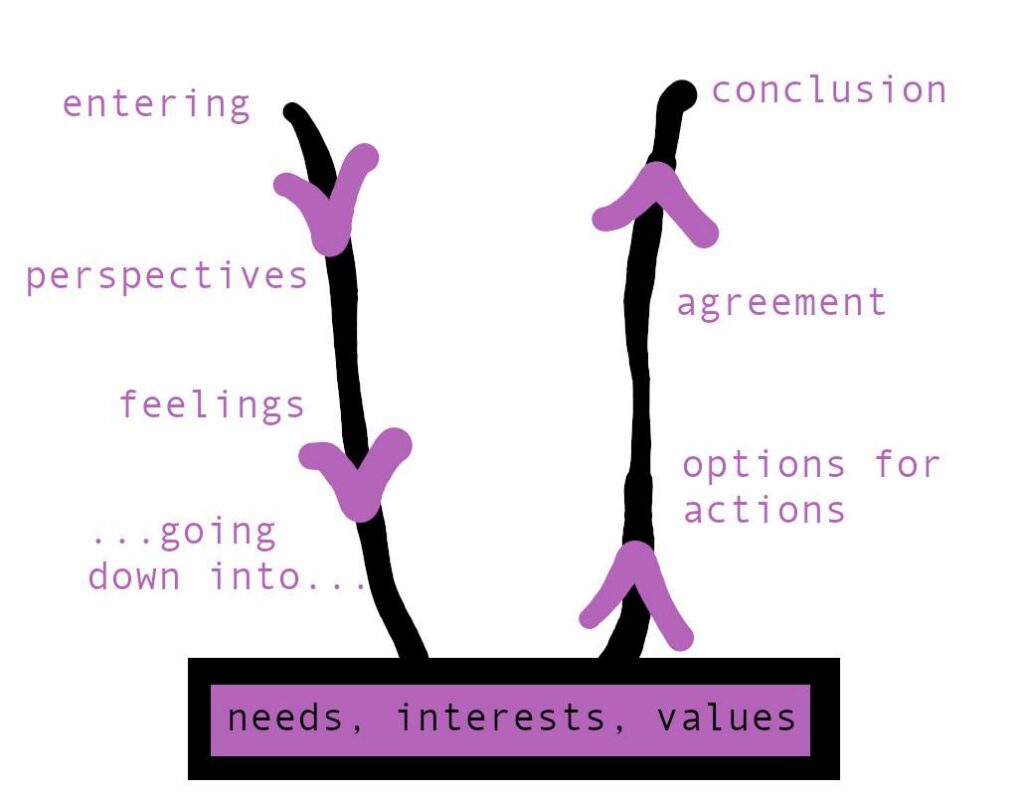
EXERCISE: THE OWN CONFLICT BIOGRAPHY
30 min individual work
Paint a typical conflict of your childhood
- Bring your thoughts down with a pen: conflict styles of parents, common topics that you remember, etc.
- Abstract or tangible (drawings, words, feelings, etc)
- What themes, feelings, and roles appear (in you and others)
Conflict experiences through life phases
- With the working paper you can find here
- Explore with the help of leading questions
- What themes, feelings, roles, were relevant in which part of your life
2x 10 min exchange with mutual active listening
- One person tells, the other one listens, then summarizes and rephrases
- What themes and conflict management styles did you find?
- What changed through time, what stays the same, where are you today?
POWER
Mediation stands for a consensus-oriented and cooperative togetherness
Power structures influences that – we try to empower instead of pacify or justify power imbalances
We try to move away from blame, shame, fault
To thematize power too openly can be damaging for the mediator’s neutrality
Common consequences of power imbalances in a conflict resolution situation:
- Impediment and prolongation of the process
- Unbalanced representation of interests (if we are not able to balance the power imbalances)
- Focus of conflicts are moved
Power dynamics in a group setting can often be read from the room:
- Who is moderating? Who gives input? Who is doing the evaluations?
- Who interrupts whom?
- Who raises their hand, who talks with easy, who adds input more than others?
- Who has spoken, who has not?
- What voices finds more hearing, what is seen as important?
- Interpretation power if one person speaks as representative of a group.
- Language skills, to be able to express oneself or not
- Attributed privileges: class, age, gender, race, etc
- Technical requirements, to take part is also dependent on your knowledge and access to technologies
LEVELS OF POWER
Personal
Interactive
Structural
- Omnipotence: I can do and allow what I want
- Power to shape things: I can decide the essentials of my life and co-create my surroundings
- Counterpower: my interests have influence in a discourse and cannot just be overridden. I can avoid negative consequences because my protest gets enough attention
- Blocking power: I can bring my protest to expression and can block or raise the risks of bigger actions. I cannot change them but at least i can (hiddenly) punish them
- Powerlessness: (or founded resignation) I am subject to the will and power of others and for me only remains a passive acceptance of the situation, trying to protect myself when possible
(What is actually a powerlessness VS where is the concept of powerlessness strategically used to put oneself in a victim position and use this in a powerful way?)
SOURCES OF POWER
Organisational power: being equiped with competencies for act and organisation
Bodily power: physically fit, gender, age, health, attractivity, physical strength. The possibility to make your own will happen through your own body
Power of position: the chance to decide over people, to redirect and take away their powers, resources and tasks
Power of resources: equipped with economic (or possibly economic) resources, control over the access to resources
Power to model and articulate: equipped with cognitive and social skills, confidence, durance, possibilities, discourse and necessary knowledge, understandings and definitions can thus be influenced and decided
We have also elsewhere elaborated on and introduced some exercises and ways of soft power that we have experienced in specifically non-hierarchical groups.
THE POWER AS MEDIATOR / BEING AWARE OF YOUR OWN POWER
Before:
- Awareness of the roles or positions within the group (try to figure it out in the pre-talks)
- Rules and frameworks
- Increase your understanding of mechanisms of discrimination and supression
- Making transparency possible
During:
- Explicit mentioning of non-equal patterns of talking
- Manage the way of sitting (more on this later)
- Line-up exercises to make dynamics and structures more visible, attainable, and encourage reflection
- Maybe individual talks in between, as needed
- Interrupt in acute situations: in moments of escalation, clearly stop and physically put yourself in the middle of the parties to halt a flud of counterarguments
- Speak about empowerment
- Continue to try to dismantle power through transparency: but power cannot be successfully diminished in mediation situations, what we can do is try to make the situation more egalitarian
- Use vocabulary to as neutrally as possible point to power relations
MEDIATION
Mediation as an official method established officially in 60s/70s; but it has been a fundamental civilisational technique of navigating conflict (probably) ever since there has been human interactions.
Mediation is a conflict management tool where autonomy remains with the conflict parties. A third person creates a space dedicated to understanding the background causes of conflict, mediates between the conflictual parties, and accompanies the process.
- Exchange/mediation through a third party, as ‘impartial’ as possible (though total impartiality is not possible)
- Informal, outside of the frames of state “justice” (thus of great interests to those of us who wish to dismantle the regimes of law and justice)
- Includes all conflict parties
- Voluntary, autonomous, consensus-oriented
The role of the mediator is trying to get all parties to express their underlying feelings, not just their “objective”, surfaced view on it; only once this is revealed, we can see what is needed to resolve the conflict. If all parties are dedicated to resolving the issue, and there are no big power dynamics at play, they can be addressed and leveled. All people who are part of the conflict need to be able to express themselves properly.
Interests
Communication
Process
Strategy
Decision
Are key parts of mediation.
THE PHYSICAL SPACE
Don’t have the conflicting parties sit opposite each other but next to each other, facing you.
Depending on the intensity of the enemy image of the other, what is said can also be directed to mediators, not to the other conflict party.
During phase 1 and 2: if necessary, the two parties can be directing their speaking to the moderators
Then during phase 3, 4, 5: the two parties start talking to each other
USEFUL TECHNIQUES
Mirroring/paraphrasing (most useful during phase 2): what has been said is summarised and repeated by the mediator. The goal is that the speaking person feels understood.
Active listening (most useful during phase 3): reconfirm the presence of the listening person. Hypothetize, rephrase, confirm what is arriving at the person listening (and try to figure out: what is below, in the iceberg?). Phrasing suggestion: “If I understood you correctly…”
Doubling: speaking for the other person, to develop a deep feeling of understanding. Is used to enhance a me-relevation, feel the understanding, empathising with the other, verbalising for the other.
Can be good to use when I think I’m feeling what is happening in the person and they cannot phrase it, or only a bit/not specific enough, or they express it vaguely. Always use the I-form, short and on-point expressions, not touching the person that you’re doubling.
Phases of mediation
Use these phases as a guiding framework without being too strict. It is not always helpful to speak specifically about phases or see them as something rigid.
Tips when you are unsure about the phase:
Make little packages with the different topics – work within each world of topics
For smaller topics, search for smaller solutions, aka close a small part of the conflict
Pre-talks: understanding practicalities.
Understanding the very basics of the work in front of you. How escalated is the conflict, how many people are involved, where and how can mediation be made, etc.
Phase 1: Introducing and establishing the framework
Phase 2: Presenting the different viewpoints and the conflict itself
Phase 3: Conflict clarification: going deeper
Phase 4: Searching for solutions, finding options, exploring
Phase 5: Agreement. Establishing terms

Phase 1: Introducing and establishing the framework
Firstly, it is about establishing contact and some sort of trust. Small talk, value what’s said, listen actively. Give some orientation and maintain transparency considering what has happened until now, what is happening next, what mediation is, what it can and can’t do.
Establishing the framework:
- Topic, goal
- Time, place, (money)
- Role of mediators: taking everyones party, open-ended, trusted
- Voluntary and self-responsible commitment of the conflict parties
- Rules of talking: can be made explicit or implicit depending on what the situation needs and how heated is the conflict
- Search for common ground/consensus/approval of all parties
NOTES FOR 1ST AND 2ND PHASE
- Paraphrase to clarify things, point specifically to things the parties have in common and their differences
- Start with a few general topics: try not to get too detailed nor too many
- Practice ways of interrupting that are still respectful when the conversation is escalating or going in a different direction (also when possible solutions are being brought to the table: we are not there yet!)
- Try to grasp all conflicts and parties involved
Phase 2: Presenting the different viewpoints and the conflict itself
- Practice active listening, give time and space, function as ventile
- Collect topics: what should be viewed in more depth? Collect and prioritise topics
- See the conflict perspectives: have the conflict parties describe what has been lived and its background. Work through to find information, consensus, and dissensus. “Depoison” what has been said, phrasing it back to the person to see if you got it right and show the depoisoned potential.
- Dynamics of the second phase: both want to convince and be in the right; is afraid of falling short; using accusations or coldness. It can be tangible/logical or emotional. The talks are mainly done through the mediator (both parties addressing mediator), not directly between the conflict parties.
Notes on mediator role:
- Question/paraphrasing only for the purpose of understanding, not giving input
- When a conversation is escalating/switching direction, interrupt – “First of all, a general request…”
- Empower second person to not base their statements on the first person
- Second person can make bullet points/summarise/but start from the beginning of their view
- Leading question: “How do you perceive the conflict?” / “What is the conflict about from your point of view?”
- Take notes on general topics and the ones you see they need to be worked through.
NOTES ON COLLECTING TOPICS
Which topics are part of the conflict and should be spoken about in the mediation? Make a list, brainstorm, columns, write down as you go. Questions that can help guide you:
- Explain your situation to me, then summarise focusing on commonalities and difference?
- Why are you here?
- I heard, that … is a topics that needs to be talked about. Is that a topic for you?
- What do you think needs to be discussed in relation to this?
- Where do we want to start?
- What does security and worries mean to you?
- Possible to arrive at partial solutions, then “what topic comes next?” start again from scratch, go in circle
- Or halt solution-searching process if it seems it is something to which roots’ you haven’t arrived yet. “That is already going in the solution-direction. I’m noting it down. Is it okey if we use this time to continue with …?”
The topic list shouldn’t become a list of wishes (for example, respect, getting heard is not a topic list).
Once you have collected the topics on the table, and the situation seems ready for it, try prioritising them together. When you are able to enter into prioritising topics, this is a first success.
In this prioritising part, you as a mediator can make suggestions.
After a bit of ping-pong there is usually a landing in the conversation. Often takes less than 15 minutes, each party speaks 3-5 minutes, then mediator summarises quickly, outlines the commonalities and differences, mentioning the topics noted as needing more work.
EXERCISE: SECOND PHASE
Exercise in small groups on identifying conflict topics
- Decide what conflict you want to focus on
- Short presentation thereof, clarifying understanding questions
- Exploration of the conflict in relation to
- Where (frames, how far does it reach): systematic components, dependency on wider systems, part-taking and exclusion, context: work, private, neighbourhood?
- Who (constellations, people, relations): conflict parties involved, how many are there, inter-and intragroup, hierarchies – formal, informal
- How (escalation, discharge): escalation steps, time frame, intensity and inclusion of one person, how close is the conflict to the people involved
- What is it about (objects, contents): assessment or evaluation conflict, goal conflict, conflicts about values and norms, distribution conflicts, relations in the centre of conflict (discrimination), roles in conflict, competency-conflict?
- Build hypotheses:
- What content level is in the focus for whom?
- What roles can the other content levels play?
Phase 3: Conflict clarification: going deeper
Illumination: complexity, intention / action / results, interpreting patterns
Deepening: understanding and disclosure, issue and reasons, recognition
Clarification: patterns and images, taking emotions seriously and express these, change of perspective, understanding
Cooperation: willingness, room to play, needs
MEMOS FOR PHASE 3
- Stay with the topic, don’t get ahead of yourself
- Allow breaks if the situation seems mature for it
- Focus on arriving at clarity instead of speed
- Push for meta level to come out, enter into the realm of emotions and needs. Here it can be helpful to allow chains of feelings to form, snowballing in the direction which takes you deeper into the values and emotions of the persons.
- Try to have the courage to interrupt, to catch immediate emotions coming up and highlight them for both parties to be able to notice them clearly and react.
- Be concrete
- Work according to the situation: what is being offered by conflict party
Phase 4: Searching for solutions, finding options, exploring
Phase 4 is about opening up and collecting options. As soon as the first ideas come up, phase 4 begins: moving “into it” is not a rigid process but more of a flow. When you hear ideas came up, bring them up directly: “ah, there i already see a solution”; “what more can you think of?”; etc. When there are doubts (“yes, but…”) collect them for phase 5. Phase 4 is only for collecting!
The key process in action in phase 4 is negotiations. Situations of negotiations are everywhere: mostly we do it intuitively and never learn it specifically.
Harvard concept of mediation
(very influential, ideologically from our perspective questionable, but still worth mentioning):
M – make the separation between people and things (relations and results)
There is always a level of things and a level of relation to a conflict/interaction of any kind: conflicts are so complex, that the other side increasingly becomes synonymous to a problem. First, we need to help the parties move away from the demonising of the other party, to realise that both parties are people, and ultimately want to have good relations. Secondly, recognising that they have a common thing to resolve. It is possible to protect the human relationships involved, while being firm or insisting on the substantive issues at hand.
O – rienting around interests, instead of positions
What is beyond the surface? Understanding and exploring the iceberg of interests, motivations, intentions, goals, needs, underneath the two positions on the surface. Look beyond what parties are demanding (their “superficial” positions) to understand why they need it (the deepest part of the iceberg, their underlying fears and desires).
O – ptions for mutual gains
When interests are clarified there is a window of possibilities. Look for commonalities and cross-cutting themes, to examine how the different interests can be met? A conflict is not a zero-sum game, mutual gain is possible.
N – eutral criteria for selection
Neutral criteria = things that are independent from the will of the person, for example market prices, rules, law, guidelines. The intention is to be neutral – but there is no such thing as completely neutral, so “neutral”, external and independent criteria is applied to give some counterweight to the conflict parties involved.
EXERCISE: GAME OF NEGOTIATING
2-3 min time per step
Step 1: each person decides individually 5 associative terms to negotiate
Step 2: in groups of two or three, everyone presents and argues for their terms, and reach a consensus on 5 terms in total to continue with
Step 3: in the whole group, each group presents their terms and argues for them, in the end the whole group should reach a consensus of for 5 of the total terms
Evaluation: what was helpful? What was annoying? What strategies were used? Are you happy with the result, with the process? How did you feel?
Being happy/content with the process is just as important as being happy with the outcome. When you are happy with the process – i.e. you felt heard, you managed to take part, you were made to feel valid and validated – you will most likely also be happy/content with the result. The process and possibility of taking part is in this sense more important than the actual result. Predefined results/alternatives tend to make for less content participants, since they don’t get to feel like they have the autonomy, and they will be less keen on putting agreements into action.
Phase 5: Agreement. Establishing terms
Phase 5 is taking everything into account and wrapping up.
- Select criteria upon which to base the solutions
- Look again at the collection of topics
- Bring them up, then find an agreement – a concrete agreement with a division of responsibilities
- Consider the needs: who still needs something? Who takes on what?
- Schedule, concretise more complex tasks, set up a timeline
Possible pitfalls to be attentive of:
- Even if the conflict is already resolved or seems to be so, do not leave out phase 4 and 5
- Don’t bring any of your own ideas for solutions in (even if they seem obvious to you) but you can hint at the way there to a conflict party (for example: I’m hearing this from you, and this from you. Does that fit together somehow?)
- Accepting rushingly a solution (by one conflict party) – leads to euphoria, or false euphoria, where all seems resolved but in the end the solutions are not concretised and the needs are not met. Try to reach concrete solutions: how exactly are you imagining this? Stay with the topic, even if euphoria over resolving the conflict kicks in.
- Options is not solutions: we need to arrive at concrete solutions, not just possibilities of such.
- Take resistance you are met with seriously and ask it out until the underlying factors are (at least somewhat) understood.
- Definitely note the agreement physically
Group conflicts
Since on this page, we are working on anarchist conflict resolution and community-building, we will include some notes on group conflicts as well. They are, however, more complex than 1-on-1 conflicts, and we believe it is helpful to practice conflict understanding and resolution skills on 1-on-1 conflicts before trying to resolve group conflicts. But: how do we learn if we don’t practice? And often we are confronted with group conflicts which need resolving without having the proper resources and experience – so reading and practicing something seems preferable to not doing so.
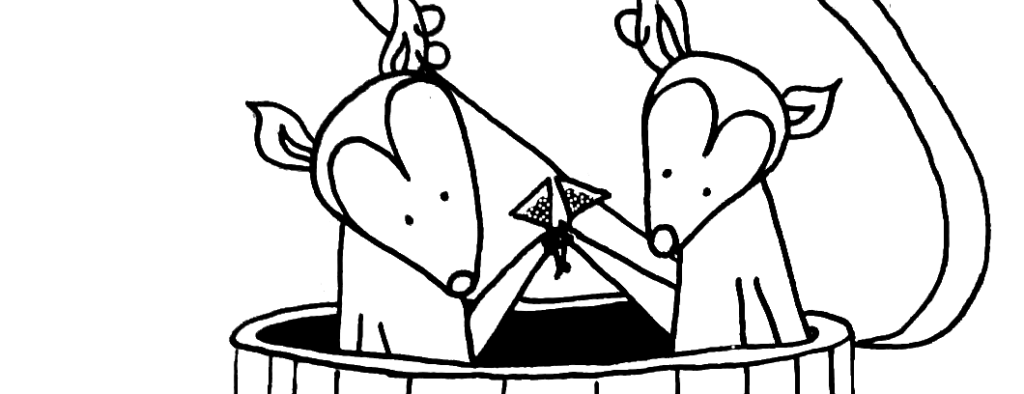
The bigger groups we are managing, the more complexity. This means less personal depth, more selection, more moderation work. Adding to this, time and capacities are often limited. Here we need to keep a focus on power dynamics (mechanisms of exclusion, adapting pressures, etc).
Groups are their own organisms which ways of functioning we want to understand, draw attention to, and critically examine.
From about 18 people involved is a big group, which necessitates a different kind of mediation, a delegation system for example (which we will not elaborate on for now).
Already understanding the room can give us a lot – sometimes only that is needed to understand the dynamics.
When one person is missing, that is an expression of conflict dynamics: we can find a way to manage those situations not a real solution to it.
You can work in different settings as needed: with the whole group, with delegated people from the conflict parties, with separate conflict parties or with the “leaders”.
EXERCISE TO IDENTIFY AND ADDRESS POWER RELATIONS IN A GROUP SETTING:
Have the group stand in a circle and make statements. Depending on the amount to which you agree you go towards the center of the circle, situating yourself in the group and physically engage with the others and their position in the group. This can be a good way to not try to intellectualise things, but rather embody them, and bring people into conversation with each other through their body, getting close to others.
Some notes on doing this exercise with groups in mediation:
- This is not an ad-hoc exercise to do, specifically applied to understand and encourage reflection about power dynamics. Reflect beforehand if it’s good to use this kind of exercises. there can be a lot of emotions and stress related, you need a lot of sensibility of discrimination and social competencies
- Thematise beforehand that it can be hard to work through
- When there is a high risk of escalation, the method shouldn’t be used
- Usually works best when integrated in phase 4
- During this exercise thematic questions shouldn’t be asked, the focus is on emotions
Statements useful are depending on the situation, but can include ones that allows you to examine your role and your feeling of empowerment, taking part, having power in the group:
- I feel able to speak up in the group
- It’s easy for me to phrase what it is I want to have said in front of the group
- When I speak, I am listened to
- What I am saying is taken seriously
- I understand and agree with the collective vision/goals that we have
- I feel able and comfortable to retell those visions/goals to other people
- I have access to the important/necessary information
- I have access to the important skills and tools
- Lack of information, skills, or tools is never an obstacle to me acting autonomously
- I feel that we could improve our informationsharing practices (collect suggestions!)
- I feel that we could improve our tool and skillsharing practices (collect suggestions!)
- I am able to be physically present as much as other members
- My physical presence influences greatly if I feel included, part of, listened to, respected as part of the group
But, again, the statements should be tailored to each situation and it’s possible that this is not the direction that you need to go in in the group conflict you are trying to mediate, so try to be creative.
First, present the statements, and give some time for personal reflection: how do you feel in relation with this lining up? What conclusions do you reach in regards to your position within each group?
Then do the physical lining up exercise and have the conversation with the whole group:
- Allow for time to understand the questions
- The point is to compare relations and see them more clearly
- Emphasize that there is no need for individuals to expose themselves
- Are there feelings of guilt or shame? Can be related to power that you do not have or power that you have
- Principally never only ask one person during line-up exercises: go all or none
SCENARIO 1. TWO PARTIES ARE IN CONFLICT AS PART OF A GROUP
In this case, we would centralise the apparent centers for the conflict, while also involving the rest of the group and try to take into account the power dynamics at play as well as the meaning of the conflict for the other people than the two conflict parties.
The two conflict parties could both try to get the group on their side, and they could also feel as the scapegoats of the conflict.
The rest of the group: could probably assign themselves to one conflict party, not understand the conflict, feel involved (nor not) and touched by it (or not)
For the rest of the group, the perspectives of conflict are added – the levels of knowledge of the conflict are different
- Are there representatives for more people involved in the conflict? Who is at the bottom of it?
- Hierarchies, roles assumed?
- What does the conflict mean for the entire group? Not just a matter of the conflict parties in this case
Is there a conflict of representatives? Who has something to work through with whom?
Responsibility outsourcing dyamics: on both sides there can be a mechanic of avoidance, or we can have one conflict party putting themselves into representation of the group
One possible constellation to work in is to put two people in the middle of the room and do mediation with them, while the others are in the background – but only possible for limited time.
SCENARIO 2. A CONFLICT WITH MORE PEOPLE INVOLVED
Here, we focus on making diversity in the separate conflict groups visible. Conformity within the parties downplays nuances in opinion, making these visible is key to break up the antagonistic, homogenic stance of the conflicting groups.
Finding consensus is more difficult – but when we work in groups, the demand to find a perfect solution is usually less high
With the power that comes with being the moderator, we should try to work against discriminatory structures of power imbalances
Separate the two camps from each other, do not situate them physically against each other, like this it is more easy to see differences within the group
Highlight in-between positions coming from the background
“Fishbowl” structure – a marking of a circle of inside and outside, where the conflict parties are either outside or not allowed to speak, mixing up the conflict party groups
- There is often an avalanche of conflict points: different people feel different things are at stake
- Coalition-making: why and how?
- Commitment necessary by all people involved, try to search for it, activate it, actively confirm it
- Interpersonal conflicts between people plays a part
- Role distribution within the parties – who gets to talk?
- Varying sizes of parties: also a source of power?
SCENARIO 3. MULTIPLE PEOPLE INVOLVED IN MULTIPLE CONFLICTS
Here you find only a mess and don’t know anymore, where is what and how things are connected. The base of it all feels unstable and many then enter into themselves, disengaging with the needs of others.
First thing is to sort out, look what is there – at the same time, the focus often goes to the people who are complaining the loudest (and this is hard to avoid).
Make a lining up exercise, and in this with body language, opinions, looks can already bring some conflicts to the surface.
- Everybody is silent / everybody talks / only some people speak about different things: try to figure out the more charged topics and that which seems to upset and bring to surface emotions
- Some people without the feeling of belonging to the group, not feeling like they are touched by the conflict?
- Different types of conflicts to be taken into account, as well as the hierarchies in conflicts
- So: also necessary to identify and try to balance out hierarchies in the group
- There can be a widespread helplessness and exhaustion due to complexity and diffusion of the group constellation, in comparison to the an often greater clarity in the own, interpersonal conflicts (both for the mediators, as well as the involved conflict parties)
- Different and multiple conflict types can meet each other:
- Mutually interdependent conflicts – where are the conflict limits?
- Multiple possibilities for resolving vs more complicated finding of consensus
- Different conflicts or topics are included in the conflict
Then, maybe one-on-one methods are necessary, after sorting out a bit of the mess of the pieces included in the conflict. Sit down with the people who seem to be at the heart of the conflict to understand their needs and feelings.