«The time has come to take responsibility.» – Manifesto Ad Nauseam: Apuntes contra el gueto político
Written by Liza collective and translated to English from Spanish. The original article can be found here.
Ever since I recognize myself as an anarchist, I have always been an «idealist» or, to put it messianically, a «believer» in The Idea. I was fascinated (and continue to be fascinated) by all the stories and experiences that Anarchism has contributed, fought for and defended in the name of a conviction that a more dignified Humanity is possible. I always liked texts with a speech that appealed to «ignite a spark of consciousness that transforms the instinct of mutual aid into the architecture of a society without masters, where bread and freedom are universal and inalienable rights» or where they talked about the «end of the exploitation of Man over Man» and the «emancipation of the people by the people themselves». I believe that, from this interpretation, my logical conclusion was that ego and personalism does not have a place in a universal project.
Perhaps that is why it was so incomprehensible to me seeing certain dynamics within the libertarian movement. I’m not talking about real political differences, which are necessary. I speak of eternal beefs, ego wars, settling scores disguised as principles, social capital accumulated by pointing out the rest and personal conflicts artificially elevated to a political issue. I have always seen the anarchist struggle as something incompatible with the ego. Not because we don’t have pride, wounds or a desire for recognition. We have them. All of us. But a militant ethic should serve precisely to put that in its place. If we say fight for something that surpasses us, the collective project cannot be kidnapped by anyone’s narcissism.
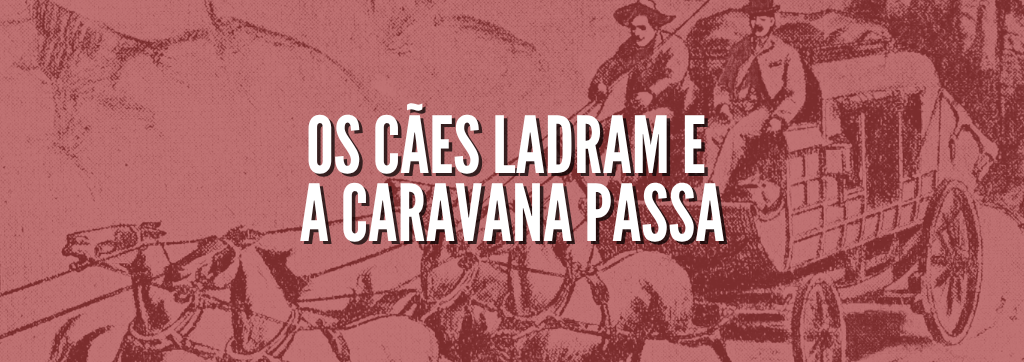
It is not for nothing that I have chosen this title: «Os cães ladram ea caravan passa». The expression comes from an old Arabic saying: even if the dogs bark, the caravan continues on its way. That is to say, there are provocations and non-constructive criticism that cannot prevent advancement. There will always be noise. There will always be those who criticize, intoxicate or need every other person’s project to fail to confirm their own superiority or to maintain their comfort. We must listen to criticism when it is right and accept our mistakes, but we cannot turn every noise into a fear that paralyzes us.
Rafael Viana da Silva points out in their text Anarquismo contra o Anarquismo – Menos complacência, mais autocrítica a widespread confusion in the libertarian movement that has done us a lot of harm: taking anarchist freedom as «doing what you want» and individual autonomy as ethical relativism. A freedom without collective responsibility does not produce libertarian militancy: it produces whim, informality, personalism and a bourgeois caricature of the anarchist as someone incapable of sticking to agreements. Anarchist ethics is not demonstrated in everyday coherence but in fulfilling what one assumes, not disappearing when it is time to sustain a task, not turning each criticism into a personal attack, not using the assembly as a stage for the ego, not confusing charisma with legitimacy.
And here appears one of our big problems within the movement — the lack of self-criticism (of course with its due exceptions) and the reproduction of a self-consuming movement. We are the first to detect and point out other people’s contradictions, but it is difficult for us to look at our own. We know how to make devastating statements against other organizations, but many times we do not know how to say «here we failed, here we were unfair, here we acted out of pride, here we confused a personal wound with a political position».
A libertarian (and also revolutionary) movement without self-criticism rots from within. It may have impeccable speech and a combative and appealing aesthetic, but if it is not able to review its practices, recognize errors and transform its dynamics, it ends up doing more branding what politics.
We have also too often confused horizontality with lack of responsibility. As if organizing, evaluating, asking for explanations, completing tasks or maintaining agreements were authoritarian practices. They are not! Why would it be authoritarian for an organization to remind you of what you collectively agreed to? Collective responsibility is not punishment or blind obedience. It is understanding that the common only exists if someone supports it. That an assembly does nothing by itself. That an organization does not have arms or heads separated from its militants. That each person is responsible for their own organization and for fighting for things they do not agree with. If no one does their part, The Idea becomes liturgy: much talk, little action. It makes me think about the often-made internal criticism in anarchism, that there is a lot of theory but little action – maybe our problem is not so much an excess of theory but internal and external bad practices…
On the other hand, in certain spaces a culture of fear of making mistakes, fear of speaking, fear of not using the perfect word, fear of a disagreement being read as violence, fear of clumsiness becoming public condemnation has been created. And when a political culture produces more fear than courage, more calculation than honesty and more complacency than criticism, we have a problem where the center is punitivism disguised as radicality. And mind you, I’m not saying this to deny real damage. There are attacks, abuses, violence and miserable behavior within our spaces against which we have to act relentlessly. There are serious things that require protection, boundaries, and consequences, but it is one thing to confront real damage and another to reproduce, in small terms, the prison and punitive logic that we claim to combat: good and bad, saints and monsters, expulsion as the only answer, reputation as a court, rumor as evidence and lynching as pedagogy.
In the text How We Handle Harm from the Punch Up Collective, a small anarchist collective from Ottawa, Ontario, focused on building resilient radical movements, they insist on something fundamental: not every conflict is abuse, not every disagreement is violence, and not every discomfort is harm. If everything is named the same, we stop understanding what is happening. And if we don’t understand what’s happening, we can’t intervene well. If assuming a mistake means automatic social death, no one is going to truly take responsibility. People will learn to hide, justify themselves, lie or act out regret. A serious militant culture has to make responsibility possible without turning it into a punitive spectacle.
It must also be said that many problems between organizations are not political, even if they present themselves as political. They are personal.
Poorly managed wounds, emotional ruptures, envy, competitions for symbolic capital, old fights, informal leadership, insecurities, resentments. All that is dressed up as policy, ethics, strategy and principles, but the sad reality is that it is an ego problem. And to be clear: mixing the personal and the political like this is a mistake. Of course, the personal has political dimensions, but it is another thing to turn my personal dislikes into a universal political criterion and condition the pace of my organization to move to the rhythm of my wounds.
And I also want to make it clear: using bourgeois or liberal institutions to resolve conflicts between comrades should make us think about the state of our movement. Not because we have to demand heroics from anyone, nor start from moralistic positions in serious situations. But if our only response to every conflict is to delegate it to the State, its courts or its police, something is wrong with our collective ability to build a revolutionary alternative.
From my perspective, politics should be seen as a field of dispute and we have to be prepared to, in any dispute, receive, give, fall and get up with our heads raised. We have ethical codes, but the others do not, and we cannot forget that, that is why we have to be intelligent, humble and coherent but we also have to be daring, disruptive and know how to hit hard when the time comes. Bakunin already said it, «destructive passion is also a creative passion». It is about understanding that every revolutionary construction requires breaking with the old forms that tie us, like the ego-trips, the personal beefs, fear, complacency, the ghetto and inertia that reproduce the same thing we claim to be fighting. Because if the libertarian movement continues to be trapped in self-destructive and sectarian dynamics, not only will we not leave the ghetto, but we will continue to drag anarchism towards marginality. And then we are surprised and upset that from the outside they call us childish, useful or utopian idiots. But what do we expect, if we spend more energy on internal shit than on thinking about how and what we can contribute to those we claim to defend and for whom we fight?
Enough of feigning purity and let’s build a militant ethic capable of accepting error without sinking into it. Know how to ask for forgiveness when necessary. Know how to recognize reason when another person is right. Know how to face consequences. Know how to look a conflict in the eye without turning it into a spectacle. Know how to speak clearly without destruction. Know how to criticize without humiliating. Know how to care without covering up. Know how to fight without losing your soul.
Instead of rumor, clarity.
Instead of fights, politics.
Instead of ego-trips, collective projects.
Instead of fear, responsibility.
Instead of punitivism, reparation and boundaries.
Instead of complacency, criticism and self-criticism.
The anarchism that interests me is a demanding practice of freedom, responsibility and organization and not a philosophy with moral superiority locked in its ghetto without transformative capacity. Because in the end we want to destroy the State, capital and all forms of domination, but we are not even capable of destroying our own miserable dynamics.
A movement that does not know how to look in the mirror is doomed to defeat. And I am tired of sustaining defeats decorated with good slogans. I want an anarchist practice that is on the frontline of social struggles, that dares to grow, correct itself, demand accountability, to accept mistakes; but also rebellious, bold, without ever losing the tenderness of the soul in the face of the harshness of the world.
References
- Ad Nauseam: Apuntes contra el gueto político. Reedición del Manifiesto Ad Nauseam. 2026.
- Rafael Viana da Silva: Anarquismo contra o Anarquismo: Menos complacência, mais autocrítica
- Punch Up * Kick Down Distro: How We Handle Harm
- Dicionário da Academia das Ciências de Lisboa: «Os cães ladram e a caravana passa»
- Mikhail Bakunin: The Reaction in Germany
Written by Liza collective and translated to English from Spanish. The original article can be found here.