We insist on the importance of a living, present anarchism, and on transforming our relationships here and now. The state’s power lies not only with armies or police, but in its capacity to get us to govern ourselves and each other, and to recreate its hierarchical and divisive relationships through our conduct. The way that we relate, or avoid to relate, cancel and hurt each other, are products of and reproduce these divisive logics. The state is a social relationship – a certain way of people relating to one another – thus it can be destroyed (or at least, sabotaged and counteracted) by creating new social relationships. Thus, our collective power can be reclaimed through re-thinking and re-shaping how we relate to each other and how we confront power. Because power relations exist, and they will naturally arise in whichever group.
Denying the existence of power relations in all human interactions would be naive. The racist, capitalist, sexist, etc, world order plant power relations in us from our cradles. The power positions in groups don’t develop spontaneously, they are resulting out of years of social construction and conditioning. On top of this (and often correlating), the mere conception of a group of people as a specific “group” can give rise to behaviors that entail power dynamics, favoring the own group or sections within the group; when some people take on high management value tasks such as external relations, internal dynamics, information preservation, this also entails power; some people are extrovert, others introvert; some are more “well-spoken”, more educated, more self-confident; and much more. All of these things entail power relations that we should stay vigilant towards.
It is not enough to claim that we abolish hierarchies. The struggle against power accumulation is everyday work, of conscience, of care, of all. Of course, this goes hand in hand with other privileges, so checking your powers is very related to checking your privileges. There is a lot to unpack there if we are striving for horizontality, and there is no one-fits-all answer or solution, but there are some things that we could stay vigilant towards. But also:

Some types of informal power (imbalances) to be vigilant towards are:
INITIATIVE: Ability to have and go forward with your ideas, act for yourself. Some people encourage the group, giving energy. They seem infallible. When they are not there, the collective seems lost and dead.
INFORMATION: Some have access to all important information. Without these people the rest can not speak, make decisions, dream, act.
SKILLS AND TOOLS: The people with knowledge or possession of certain skills and tools become indispensable specialists that need to be included everywhere, thus, also limiting on the possibility for the rest of the group to act autonomously without them.
PHYSICAL PRESENCE: Ability to be physically present in moments of collective adventure. Some are always present, they are the ones who have seen and lived the collective adventures such as assemblies, actions. They feel like they are part of the collective more than anyone else.
EXPRESSION: Ability to express oneself in speech and make oneself heard. The ability to properly express oneself in settings, maybe talking too much, listening too little, enjoying to hear oneself talk a bit too much, cutting other people off or diminishing their contributions in other ways. These people dominate assemblies and other settings and give little space and possibility for others to speak and make themselves heard.
COORDINATION: Ability to grasp a bigger vision of the collectives objectives. Some people are the ones reexplaining the important things, formulating the objectives, refocusing the debates. Without them, the collective loses their path, focus, possibly also their motivation.
Battling power dynamics as collective responsibility
One part of the problem with power dynamics appearing in anarchist collectives is of course the person who has the power, willingly or unwillingly, knowingly or unknowingly, and how they act about it. More general mechanisms for confronting people intervention-style should exist, since some people have integrated power-hungry behaviors and will defend the powers they have to the last bone. But it is, ultimately, a collective responsibility to identify, speak up about, and integrate tools to battle these.
From personal experience with being people who take on important tasks (and then get accused of authoritarian behavior) we want to make some points around this: we do not take these on because we are greedy for power or want to take up as much space as possible, but rather, to get things done. This does not always have to be the case, again, we are speaking from our experiences. In our collectives, we are often all at our very limit and it’s understandable that some people have things they are better at and prefer to do, and that some people have more life responsibilities outside of the collective than others and thus have less time to invest in the group. While we can obviously not speak for everybody, we see our collective strength in realising that this is the case and that we still are all equal in the collective. If unequal access to diverse tools of power is noted in your collective, this should be confronted – but treating the dominant person as the problem goes against what we want anarchy to stand for.
Instead, we suggest an awareness around the necessity to share and circulate certain responsibilities and roles, to break patterns of this kind. That not only requires the dominant person stepping down but other people stepping up. While in dominant positions we have noticed tendencies of people from inside and outside the collectives to bypass the collective and ask only us, then called the collectives attention to this, but still not seen much change. Thus we urge the whole collective to stay vigilant of signs that people seem to grow into leader roles, confront the person of course, but also look at their own and everyone’s role in it, and especially, react when people draw your attention to this.
If you find yourself identifying with the informal powers mentioned, it is time for you to check your behaviors and give others more space, and use your influence to empower others to step forward, to distribute roles, to introduce more egalitarian elements and ways of running things. If you are a person who often feels like others with these powers are running over you, it is time for you to try to take more space, initiate knowledge and task exchanges, introduce more egalitarian ways of organising (word shift, passing around an object to whoever has the word, going through the full circle to hear everyones opinion, etc).
Collectively, we can all make efforts to take initiative in trying to learn new skills, maybe team up with someone who is skilled at a task to do it together and learn together, so that next time the person who didn’t feel qualified can take on that task (maybe together with another person who wants to learn). Take initiative and responsibility for both sharing information in accessible ways - speech, writing and others - and to make these accessible to all. Take ownership of information and tasks in shifting constellations, and take the responsibility to acquire more information and responsibilities as well as sharing them when it is you who have access to things that others don’t. Create a trusting context where attempts, faults, errors, weaknesses are accepted (this overlaps with many other notes made on radical community and is a heart topics of ours <3). Make the schedule of the collective adaptable and accessible to different groups of people, offer mutual aid in order to simplify the access to meetings and responsibilities for others (baby-sitting, dog-sitting, relief in household work..). Identify collectively the pending tasks, clearly formulate who does each to avoid task accumulation, install circulating roles of moderation, notetaking, agendamaking, etc. Try out exercises to identify power dynamics and then tackle them from whichever directions seem necessary.
Basically, power dynamics are going to arise, and it is worth dedicating time within our collectives/groups to debate and reach a consensus on the functions, objectives, and if applicable, responsibilities of individuals and of specialised groups/working groups we create, as well as actively remain dedicated to a circulation of roles, responsibilities, and stay aware and responsible for both our own actions and dynamics in the group.
We have adapted a graphic from abcdd.org outlining this in table-form
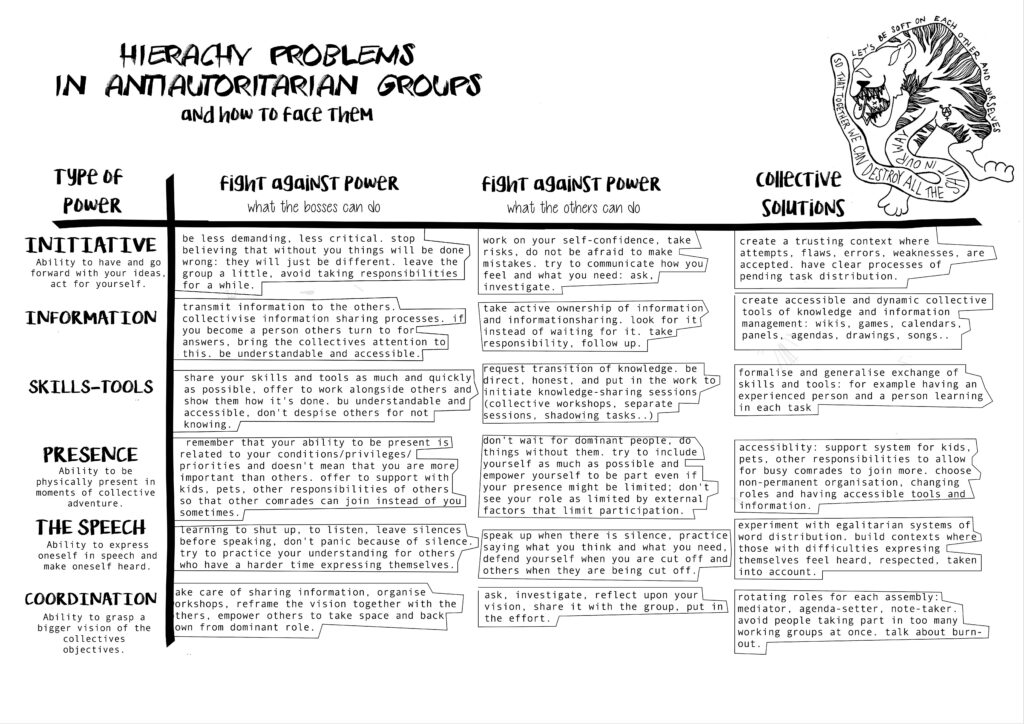
(Note: this is obviously not an all-covering list but a collection of things that we have observed in our collectives)
It can be downloaded in good resolution here:
Exercise: power in groups
One suggested exercise that can help to grasp collectively how collective roles look, how people feel in the collective, and to discover imbalances, is outlined here.
Everyone stands in a (somewhat bigger) circle. Some statements are made, and according to which extent people agree, they move closer to the middle of it. This helps to situate yourself in the group and physically engage with the others and their position in the group.
Suggested statements are:
- I feel able to speak up in the group
- It’s easy for me to phrase what it is I want to have said in front of the group
- When I speak, I am listened to
- What I am saying is taken seriously
- I understand and agree with the collective vision/goals that we have
- I feel able and comfortable to retell those visions/goals to other people
- I have access to the important/necessary information
- I have access to the important skills and tools
- Lack of information, skills, or tools is never an obstacle to me acting autonomously
- I feel that we could improve our information-sharing practices (collect suggestions!)
- I feel that we could improve our tool- and skill-sharing practices (collect suggestions!)
- I am able to be physically present as much as other members
- My physical presence influences greatly if I feel included, part of, listened to, respected as part of the collective
- …
Again, the suggestions are based on our experiences – go nuts with thinking about your own statements, maybe you can also find completely new categories of power, or ways that they work, that we haven’t thought of. We have prepared an empty table that you can print and fill out if you’d like to, or just draw one from scratch: